


TUXEDO Computers is rebasing TUXEDO OS on Debian, moving away from Ubuntu.
The German Linux hardware company launched TUXEDO OS in 2022, building on top of an Ubuntu long-term support (LTS) release to, chiefly, support its own hardware with customisations, though the distro is free to download and install on any machine.
To keep things fresh, TUXEDO updates web browsers, GPU graphics drivers and the Plasma desktop continuously, but leaves the underlying Ubuntu LTS base intact.
Now, after almost four years of taking that approach, TUXEDO’s had enough.
Why TUXEDO OS is dropping Ubuntu
TUXEDO list a number of reasons on why Ubuntu is no longer the right foundational fit for the future of their custom distro.
Firstly, development effort.
TUXEDO OS’ ‘hybrid update’ approach gets harder to maintain as the underlying LTS stack ages. Backporting core Qt packages can conflict with or break Ubuntu-repo packages. It’s an issue TUXEDO has said the Ubuntu-LTS-based KDE neon also runs into.
Users had likely already noticed the slowdown as TUXEDO OS is still using KDE Plasma 6.5 even though the Plasma 6.7 release is out. No date had been given for a move to Ubuntu 26.04 LTS, either.
Secondly, there’s Canonical itself.
TUXEDO express concerns over the company’s ‘strategic direction’ for the distro, noting that as an Ubuntu derivative, it has to either adopt or workaround changes – as is the case with snaps.
“It is becoming increasingly difficult to keep the Snap packaging system out of the operating system, as Canonical is distributing more and more applications exclusively as Snap packages while gradually pushing traditional DEB packages into the background”, it says.
TUXEDO also call out Canonical’s roadmap for AI features in Ubuntu, describing its plan as “insufficiently transparent”. It also notes a (perceived) slowness in getting security updates out to users.
So, Debian it is – specifically Debian Testing, not a stable release branch. TUXEDO OS intends to track Debian Testing permanently, offering users a quasi-rolling experience, with access to newer software sooner, and reducing the burden of backporting to a stale base.
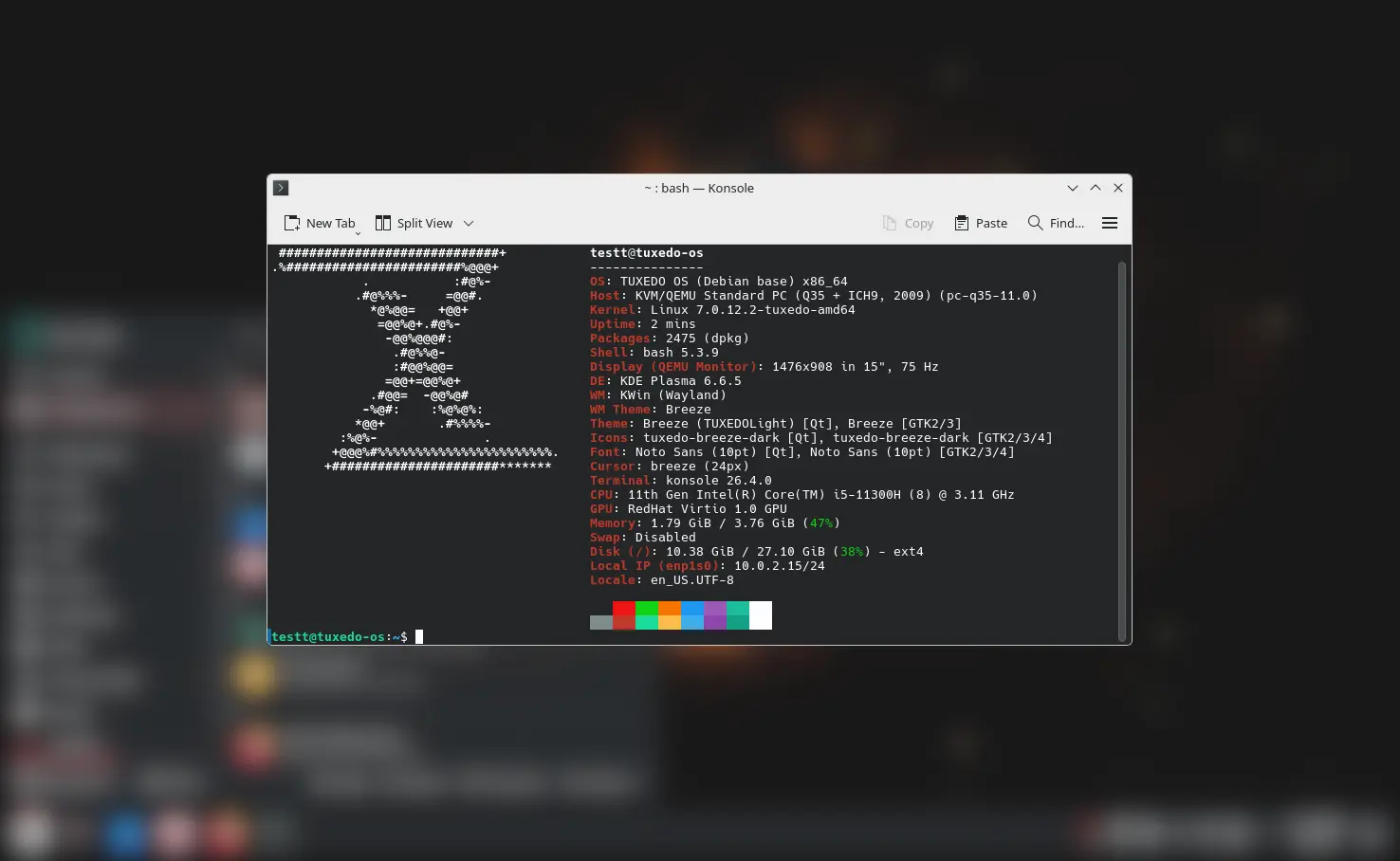
“By moving to Debian, TUXEDO OS gains substantially more independence while reducing the effort required to maintain up-to-date software”, the company say in their announcement.
“The result is a robust operating system with a clear focus on digital sovereignty—for both TUXEDO customers and users running TUXEDO OS on third-party hardware.”
Ubuntu is itself a Debian-based distro so there is unlikely to be a major change in the day-to-day user experience. Updates still come via apt through Discover or the command line, DEB packages work, and so on.
But a far bigger change will take place beneath the surface.
TUXEDO OS will use Btrfs by default, rather than EXT4. This will be paired with a SUSE-developed Snapper to take automatic snapshots after package updates, enabling easy rollback. Btrfs will be default on new installs and will be preselected in the installer.
A clean install will be required to use the new version as there’s no safe or reliable way to convert Ubuntu to Debian. For its existing users who don’t wish to lose the benefits of Ubuntu, a ‘migration path’ to Kubuntu will be made available.
The company plans to share details on other changes coming, including a new kernel cadence, “redesigned visual theme” and updated preinstalled software set in the coming weeks.
Ahead of all that, a beta version of the Debian-based TUXEDO OS is on the way – if the sound of a Debian + Btfrs + KDE Plasma sandwich sounds appetising, look out for that.
Thanks Marco