

Want to find out if the text you’re reading online was written by an real human or spat out by a large language model (LLM) trying to sound like one?
Mozilla’s Fakespot Deepfake Detector Firefox add-on may can help give you an indication.
Similar to online AI detector tools, the add-on can analyse text (of 32 words or more) to identify patterns, traits, and tells common in AI generated or manipulated text. It uses Mozilla’s proprietary ApolloDFT engine and a set of open-source detection models.
But unlike some tools, Mozilla’s Fakespot Deepfake Detector browser extension is free to use, does not require a signup, nor an app download.
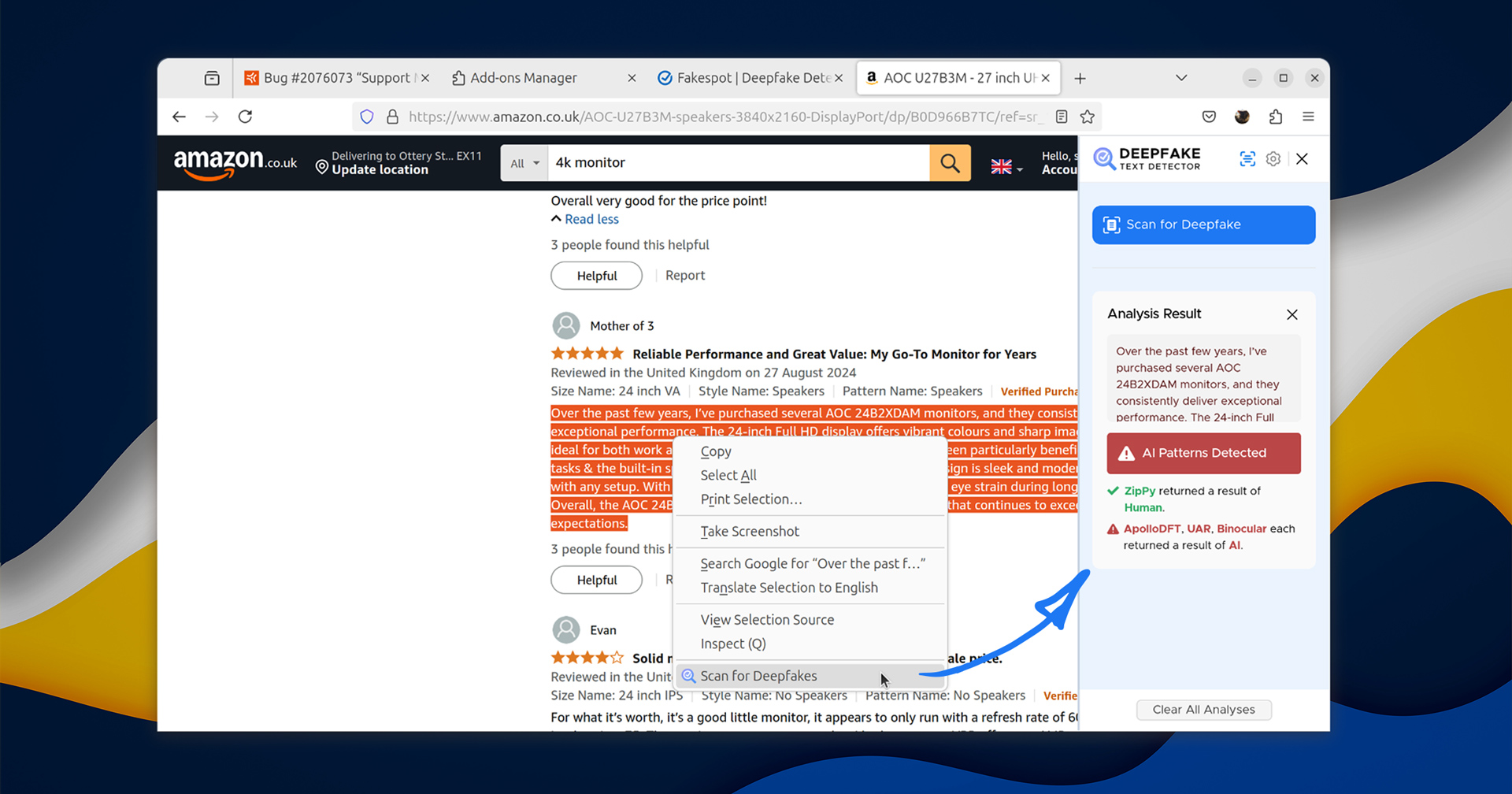
“After installing the extension, it is simple to highlight any text online and request an instant analysis. Our Detector will tell you right away if the words are likely to be written by a human or if they show AI patterns,” Mozilla say.
Here it is in action:
Fakespot, acquired by Mozilla in 2023, is best known for its fake product review detection tool which grades user-submitted reviews left on online shopping sites. Mozilla is now expanding the use of Fakespot’s AI tech to cover other kinds of online content.
At present, Mozilla’s Fakespot Deepfake Detector only works with highlighted text on websites but the company says it image and video analysis is planned for the future.
How much of a game of cat-and-mouse game will AI detection turn into as output quality from leading GPT models improve? Remains to be seen.
Though not foolproof, this add-on (and the website for it should you prefer to paste in text manually) may be a useful stopgap to help avoid sites peddling asinine AI slop in favour of those based on authentic human effort.
It AI-n’t Evil, Joey
There’s nothing inherently bad about ‘AI’ generated text, context depending.
More, it’s the way people use it: unrefined prompts with minimal guidance and input generate boilerplate, derivative text that is devoid of insight, creativity, or substance—accuracy too, often—and passed off as being by a real person.
If I read news article, an opinion/think piece, an overview or a review for something I’m considering buying or using I want to read what a human thinks of it, not what a LLM thinks a human might think of it.
Because as smart as “AI” can seem it still lacks human insight. It can’t use product and draw a conclusion based on a lived experience or from a unique set of personal preferences.
Admittedly I am biased in this since I write blog posts with wetware. That makes me a shill for the Synapse® lobby, means I’m in the pocket of Big Brain, and—gasp—one of those flag-waving, out-and-proud homo …sapiens.
Getting the add-on
Mozilla’s Deepfake Detector add-on will not have a 100% hit-rate at detecting AI-generated text. It will almost certainly flag AI text as human, and human effort as AI. Like with all things AI, a degree of human diligence remains required.
But the fact this add-on uses multiple models does mean there’s a consensus factor. That may prove reassuring to you when/if you next read something that sounds sus’ or feels formulaic and you’re curious about whether AI involvement.
Want to try it out?
You can get the extension from the Mozilla Add-ons website. It will work in any modern version of Firefox on any major desktop operating system – elevate your AI detection game today! ;)