


Times are literally changing and Ubuntu’s keeping pace – well, kinda.
In November, most of Canada will turn its clocks back an hour, but the Western Canadian province of Alberta won’t. It’s decided to stay on daylight saving time permanently rather than fall back to standard time.
Meanwhile, in September, Morocco is doing the reverse: after eight years of running an hour ahead of Greenwich Mean Time, it’s going back to GMT.
So Ubuntu has updated its tzdata package so that users in either location – or anyone travelling to them – have systems in sync time-wise. The update refreshes the database that allows the OS to know and calculate which time zone rules apply where.
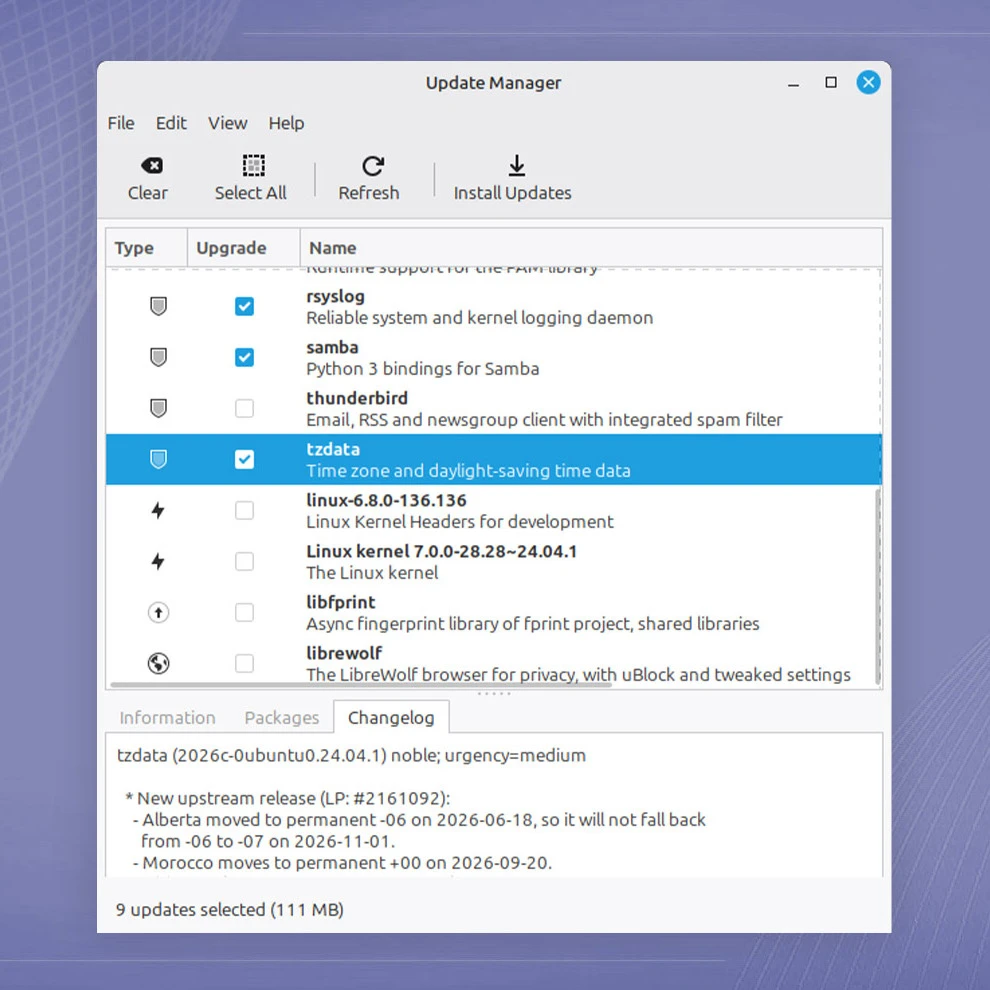
Without that update in place, Ubuntu would keep applying the old rules. And, aside from being confusing, having an incorrect system time is a security risk, which is why it can result in issues accessing websites, repos and security features.
Anyone in Alberta or Morocco won’t need to manually adjust their system time come the respective change-over dates. As long as the tzdata 2026c update (or newer) is installed, the correct times will show automatically when the clocks change.
The update is rolling out to all supported versions of Ubuntu, as far back as 16.04 LTS (still supported with the Legacy add-on in Ubuntu Pro). It’ll also land in Ubuntu-based distros, like Linux Mint, ZorinOS and Pop!_OS, that use an LTS base.
Alberta will stay on UTC-6 (called ‘Alberta Time’) all year round from 1 November 2026. Alberta’s ministers say the change leaves more light at the end of the day instead of the morning. It plans to “monitor the transition” after the first full year to ensure it’s working out.
Morocco is moving to GMT+0 from 20 September 2026. It had been using GMT+1 for most of the year since 2018, only falling back to GMT+0 during Ramadan then pushed forward again once it ends. It wasn’t popular; public pressure to scrap it won out.