


When Ubuntu founder (and space tourist) Mark Shuttleworth speaks, people listen, especially since his company, Canonical, announced a version of Ubuntu for smartphones.
At press conference held this week, the multi-millionaire revealed more details on Ubuntu Touch (the OS) and the devices that run them, Ubuntu Phone – like the fact the first will go on sale later this year.
In this post, I share six nuggets of information I learned from taking part in that press call.
1. Two Ubuntu Phones are coming this year…
You wait ages for an Ubuntu Phone – and then two turn up at once!
‘You wait ages for a bus only for two to turn up at once’ is a well known British idiom. Swap ‘bus’ for ‘Ubuntu Phone’ and that quip becomes something of a truism!
Mark Shuttleworth promises that not one but two Ubuntu phones will be released, each from a different company, by the end of this year, 2014.
They first Ubuntu Phones will be rebadged versions of Android handsets each company has on their respective roadmaps. Based on that hint, we should expect an Ubuntu version of the eight-core MX4 phone from Meizu, and something equal to the Aquaris E5 from Bq.
Ubuntu Edge? Pah – ancient news!
2. …But they won’t be available worldwide
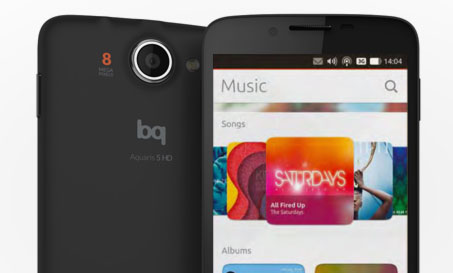
Before we get too excited about the handsets, keep in mind that they are unlikely to be sold globally
For what Shuttleworth was saying, the Meizu Ubuntu Phone will likely launch in China.
That makes sense; Meizu a big brand name in the countr and Ubuntu Touch has already gained the backing of the country’s second biggest mobile network, China Unicom (中国联通).
As for Bq, that’s less certain. The Spanish company’s Android phones are sold in Uruguay, Spain and Portugal. With the Portuguese carrier Portugal Telecom a member of Canonical’s Carrier Advisory Group, could we see Bq launch their Ubuntu Phone there this year?
On a more positive, if equally speculative, note hardware from both companies is often made available to buy online globally, albeit through third-party sellers.
3. Bigger brands will launch phones next year
2015 will bring Ubuntu Phones from established OEMs
If you’re bored sick of hearing vague statements about unnamed “household brands” supposedly interested in Ubuntu Touch, or the carriers clamouring over each other to ship it on their networks (just not yet), then you’ll want to scroll on down to the next point.
If, however, you’re now willing to put a bit more stock in such noncommittal statements now that concrete plans have been announced then listen up: Shuttleworth has said that 2015 should see Ubuntu Touch shipping on hardware from established OEMs and offered by big-name carriers in a wider range of countries.
4. 50 ‘Top’ Android/iOS Apps by launch

Big proclamations are kind of Mark Shuttleworth’s thing. Elephants (and anyone else with a good memory) may recall his 2011 goal for more than 200 million Ubuntu users by 2015.
Optimistic, perhaps.
But for Ubuntu Phone, his goals are no less ambitious. Mark said he hopes to see the top 50 Android and iOS apps available for Ubuntu Touch this year, ready in time for the launch of the newly announced handsets.
While companies like The Weather Channel and Evernote have ‘okayed’ the use of their APIs in community-made apps, big name ISVs which consumers rely on are few and far between. For every VLC port there are gaps in the shape of Twitter, Instagram, Rovio, WhatsApp et al.
Filling that will be key to the Ubuntu Phone’s appeal to general consumers.
With new focus on HTML5 web-app support, Ubuntu Touch will able to cherry pick the best of, and piggy back off the success of, platforms from Google and Mozilla. Both companies are advancing what web applications can do, blurring the lines of what ‘native’ really is.
Google plans to bring its web-based but offline-enabled ‘Chrome Apps’ to Android later this year.
5. Shutleworth thinks Tizen is a ‘fading force’
Can Ubuntu pull this off when even Microsoft found the mobile space too difficult?
Only the naive see Ubuntu for Phones as a guaranteed success story. Fact is, the project faces an uphill struggle to gain so much as a toenail-hold in a market firmly controlled by a handful of companies.
Heck, even Microsoft, with its bottomless pockets of cash and brand power, found amassing a meaningful number of users for its mobile OS, Windows Mobile, supremely challenging.
Will Ubuntu fare better?
Shuttleworth wouldn’t put an exact figure on a user-base or sales number that might constitute a success to Canonical, which suggest he is realistic about the task at hand.
But he does view Ubuntu Touch’s “convergent” gambit – whereby a phone can connect to a monitor, keyboard and mouse to drive a more traditional desktop UI – as having the potential to disrupt the entire smartphone market, carving out a unique USP.
Thing is, Ubuntu Touch isn’t the only “one OS, all the devices” play involving. Tizen, the Intel & Samsung backed Linux OS, aims to run on everything from mobile phones to TVs.
He didn’t hold back in his view of that effort.
Shuttleworth described Tizen as a ‘fading force’ that is ‘much less of a competitor than it was 6 months ago’. He also said he expect to see many of the companies who’ve publicly backed the OS ‘to distance themselves [from it]’ in the coming months.
Has he got a crystal ball?!
6. OEMs pay Canonical to ship Ubuntu Touch

Out of all the information shared during the press call, the one nugget that I found most satisfying was about money.
Ubuntu for phones provides mutual benefits for both Canonical and OEMs/Carriers that run it, as Shuttleworth explained:
“Our [OEM] partners appreciate that our business model is straightforward …We charge [them] a fee per device [and] we share revenues made from the app store with them”.
How much does that “fee” amount to? That, understandably, wasn’t disclosed. Fees are not without precedent: Canonical already does this with OEMs who sell laptops and desktops with Ubuntu. They pay a nominal fee to cover use of the Ubuntu trademark, testing and so on.
As of 2014, Google does not charge a license fee for Android but OEMs are required to pay third-party companies for certification of devices that wish to include the core Google Mobile Services (GMS) framework.
The cost of certification to gain permission to ship GMS, which includes the Play Store, Gmail and Maps apps, can run into the tens-of-thousands of dollars, per a The Guardian report.
However, Canonical is no Google, and Ubuntu Touch is not Android. Licensing fees are unlikely to be provide pure profit and instead act as contributory costs to the engineer Canonical will undertake to support, test and maintain the OS on the handsets.
Still, if Ubuntu for Phones gains traction, there is potential for other revenue streams. Perhaps companies could pay Canonical for their content to get preferential surfacing in the home screen Scopes or even have their apps preloaded – aka, bloatware?
None of that was hinted at in the presser.
But bootstrapping a Linux-based mobile OS from near-scratch won’t have come cheap for Canonical, and it has other projects (like a desktop OS) to maintain too. A true marker of success won’t be solely in how many people use Ubuntu Phone, but whether those users make it money.
In open-source, that’s never a given.