
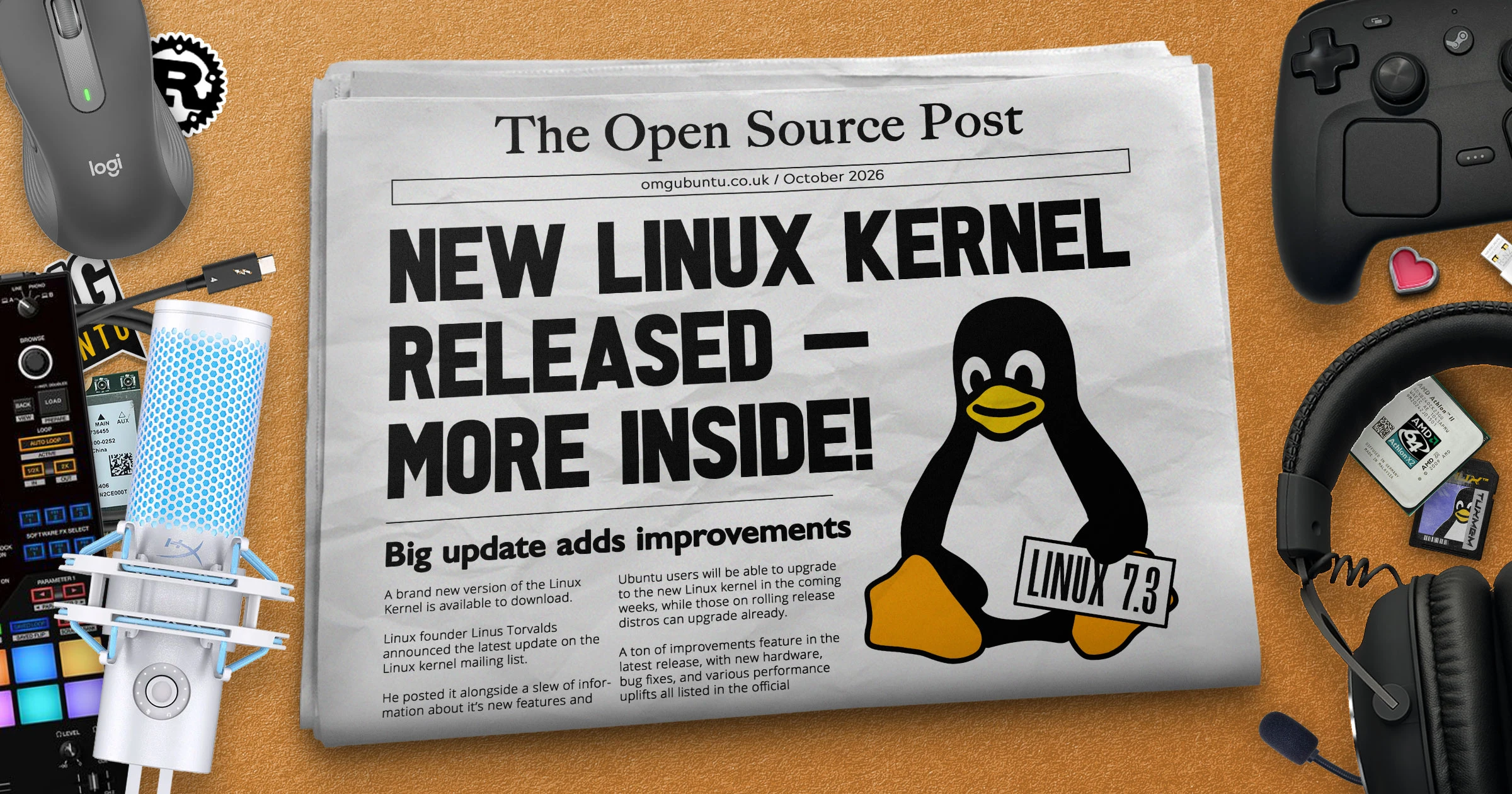

Linus Torvalds has announced the release of Linux 7.3, a new mainline kernel – the one Ubuntu 26.10 is running on.
Linux 7.3 is another big update, improving gaming performance for AMD GPUs with low VRAM, boosting ext4 I/O and reworking how the kernel splits CPU time between groups of apps to improve efficiency.
It’s expected to become the new Long Term Support version.
Writing on the Linux kernel mailing list, Torvalds said: “It’s Sunday afternoon, and this week I somehow kept my wits together long enough to keep track of the day of the week, so the release isn’t randomly delayed. Will wonders never cease?”.
They might, sadly – so must this article’s intro. On to the recap.
Linux 7.3 features
Better AMD performance with low VRAM
If your AMD graphics card has a limited amount of video memory (VRAM), Linux 7.3 handles tight memory situations better thanks to a new approach to resource allocation.
Previously, if VRAM filled up while running multiple apps, the kernel allocated space on a first-come, first-served basis. If you opened, say, a game late, it could be forced off the card’s faster VRAM and into system RAM (GTT).
In Linux 7.3, the kernel can ‘evict’ other apps’ unprotected background data out of VRAM to make room for tasks with higher priority, like a game requesting protected memory.
Valve’s Natalie Vock did the work. In tests with Indiana Jones and the Great Circle, the change allowed the game to run well on an 8GB GPU even when the settings were adjusted to push memory needs towards 9GB of VRAM.
It’s only part of the work; further VRAM management changes are on the way in future kernel releases.
Older AMD GPU and CPU fixes
The past few kernels have delivered fixes and tune-ups for older graphics cards, and that trend isn’t letting up yet.
DRM format modifiers (labels, in effect, that describe how an image buffer looks) are now available on AMD Radeon GPUs from the HD 7000 series (GCN 1.0), boosting performance in some cases and improving support for Vulkan-based Wayland compositors.
Meanwhile, old AMD Athlon XP (as well as some Intel Pentium III/Celeron) CPUs can use the SFENCE instruction for memory-write ordering without needing SSE2, resolving an incorrect requirement in earlier kernels.
Faster cgroup CPU scheduling
Linux 7.3 rejigs how the kernel shares CPU time between apps and services, aiming to keep systems responsive when background tasks are competing for resources.
The scheduler now allocates CPU time between groups of processes that run mainly on the CP and moves cgroups to a single run queue to reduce latency. A new concur mode has been made default, albeit with the option to restore the old behaviour.
The cover note said the new default was chosen in the hope that it “serves more people than it hurts“. Cgroup scheduling has been a focal point of gripes about tardiness, so changes in this area will be welcomed.
Tests by scheduler maintainer Peter Zijlstra earlier in the year showed promising results, with one game’s minimum frame rate raised from 3.8fps to 20.6fps with 8 heavy background processes, and its average frame rate bumped from 48fps to 57.2fps.
Faster ext4 reads and writes
Ext4, Ubuntu’s default filesystem, sees a set of welcome performance boosts. Parallel direct I/O writes (which skip the page cache) are faster, as is fallocate(), and a buffered-write regression was fixed.
Ext4 (and XFS) also speed up small, direct reads from disks.
Tests by a ByteDance engineer, using a PCIe Gen5 NVMe SSD, saw 4K random-read performance leap from 1.92 million to 2.19 million operations per second. Gains were higher when using io_uring to handle more reads at once.
The ntfs3 driver has basic support for alternate data streams, a Windows feature that lets files store extra data alongside their contents. The newer ntfs driver (optional since Linux 7.1) adds read-only support for Windows overlay filter (WOF) compression.
Steam Controller, MSI Claw & more hardware support
The 2026 Steam Controller bags an initial driver in Linux 7.3, and a new MSI Claw gamepad driver was added by Valve. The original Steam Controller driver adds support for more sensors.
The HyperX QuadCast 2 USB microphone now reports when it’s muted, and the kernel copes when the microphone of the Logitech PRO X Wireless headset is attached or detached.
The Logitech HID driver (used for mic) supports HID++ 2.0 reprogrammable buttons, which owners of the Logitech Signature M650 will be pleased to hear.
The pricey Pioneer DJ DJM-S11, a 2-channel DJ mixer, picks up USB audio support, and USB passthrough on the M-Audio Venom synthesiser was resolved, while internal mics are now detected on TUXEDO laptops based on the TongFang XxAF5xxx.
The kernel now checks USB-C cable capabilities for altmode support (e.g., DisplayPort and Thunderbolt) before it tries to use them, which should resolve issues with unsupported cables being assumed to support things they don’t.
Sensors on more ASUS motherboards, like the ProArt Z690-CREATOR WIFI and ROG CROSSHAIR X870E HERO, now report. Realtek’s 8922DE and 8922DE-VS PCI Wi-Fi adapters are newly supported too.
Apple M3 Pro, Max & Ultra support
Bring-up (very formative support) for Apple M3 Pro, Max and Ultra chips ships in this release (Linux 7.2 added initial support for the base M3). Don’t expect too much; the M3 support is early and not as immediately usable as the kernel’s M1 and M2 support.
Other Apple-related changes in Linux 7.3 see the kernel’s built-in SMB file server (ksmbd) gain optional support for Apple Time Machine. This will let Mac users use Linux-based network shares to back up their macOS systems.
And Apple’s Studio Display reliably works with AMD GPUs, as the AMDGPU DC (display core) driver copes with the monitor’s dual-stream tech better. Desktop compositors no longer see the Studio Display’s’ tiled 5K panel as two separate screens.
Other changes in Linux 7.3
Other notable improvements in this kernel:
sched_extsub-schedulers let cgroups run BPF-based schedulers- Block devices support
RWF_DONTCACHEfor selective caching - New sandboxing technique with
failfs&fchroot - SMB server support for Apple Time Machine
- PID 1 and kernel threads now have separate filesystem states
- New library APIs for common AES encryption modes
- Up to 5x faster btrfs
fsyncoperations (in some scenarios) - FUSE gains buffer pools and zero-copy I/O over
io_uring - Nouveau adds NVDEC (needed for Vulkan Video in NVK)
- Swap gains
swap_opsstructure to aid future improvements - Big TCP packets in UDP tunnels managed by VXLAN & GENEVE
- Rust PowerPC support
Also added was a huge slab of LLM-assisted code to let hypervisors track virtual machine memory usage by marking page ranges as ‘no access’ to reclaim cold pages.
How to get Linux 7.3 on Ubuntu
Ubuntu 26.10 ships with Linux 7.3 out of the box, and will pick up the final release via software updates in the coming week or two. If you use Ubuntu 26.04 LTS, you’ll receive this kernel in the next HWE update, due early next year (2027).
On other Ubuntu releases, you can install Linux 7.3 at your own risk using Canonical’s mainline kernel builds. However, those are not recommended. They lack Ubuntu-specific patches and drivers. They come with zero support, get no security updates, etc.
If your system is working well, there is no reason to chase newer kernels for the sake of it.
The Linux 7.4 merge window will open tomorrow, when the fun starts anew. It’ll be interesting to see if it surpasses the new records set by this kernel.
Per stats from LWN, Linux 7.3 included 18,765 non-merge commits from over 3,000 developers. Of those, 807 were first-time kernel developers. That is a sizeable uptick in newbies.