


The Document Foundation has released LibreOffice 26.8, a major new version of the open-source office suite for Windows, macOS and Linux.
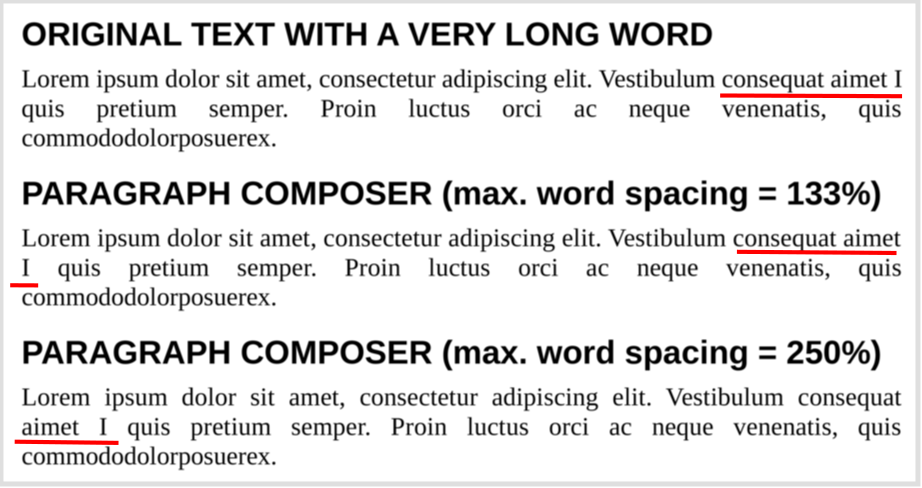
Among the changes is a new Paragraph Composer. This improves the way Writer handles justified text. In many word processors, justified text is stretched to create straight edge on both sides of the page, but this can look uneven. Some lines packed tight, others gappy.
But with LibreOffice 26.8’s new Paragraph Composer, spacing gets balanced several lines at once, rather than one at a time, which can result in a better overall look:
Other typography changes in LibreOffice 26.8 include native support for variable OpenType fonts, letting you tweak “axes that adjust letterform contrast and proportion to the size at which text is set”. Baseline grid alignment was added for text in frames too.
Right to left, such as LibreOffice now detects the direction of a document automatically when it is opened or pasted in, rather than requiring the user to set it manually, and Calc, the suite’s spreadsheet tool, sets cell text direction automatically if right-to-left text is entered.
And there’s better support for other kinds of languages, including those written right to left, such as Arabic and Hebrew, through the suite:
- Writer detects paragraph direction when opening a file or pasting text in
- Calc sets writing direction when right-to-left text entered in empty cell
- Bidirectional control characters are now shown
- Object resize handles behave in right-to-left and vertical CJK documents
- CJK text grid option renamed
- Math adds named functions and operators for N’Ko and Adlam
“None of this work has a commercial market”, The Document Foundation said, noting it did it because it have to justify features based on return. A circular argument, somewhat, but the sentiment hold: FOSS can focus on what matters, more than what pays.
Notebook bar

LibreOffice 26.8 adds the colourful Notebookbar background options I reported on in June. These are intended to make it easier to tell apps apart, but it also looks fresher in my opinion.
Changing theme colours no longer requires an application restart, which is a big timesaver when you fancy exploring the customisation options.
Other changes in LibreOffice 26.8
Interoperability (boring word) is always a hungry area of improvement. People may opt for LibreOffice but still need to share files with colleagues and collaborators who use Microsoft Office, and vice versa.
In Calc, LibreOffice 26.8 nixes a quirk that damaged some newer chart types in Microsoft Excel documents that were opened and edited in LibreOffice, then opened again in Excel. LibreOffice still can’t handle those charts, but it no longer screws ’em up!
More Calc improvements:
- Calculated Fields added to pivot tables
- Data validity silently rejects invalid entries (again)
- Cell styles support relative font sizes
- Shuffle command randomises the order of cells in a range
- Border toolbar button remembers and reapplies the most recently used style
- XLSX referenced cell line handling
- XLSX form control elements show in the Navigator
- Table style editing (also in Writer)
Writer also offers:
- Faster opening of large documents with images
- Draft view hides headers, footers and margins for distraction-free working
Changes to Draw and Impress in LibreOffice 26.8:
- Impress and Draw now support multiple page sizes in a single document
- Impress slides can be organised into named groups
- 16:9 and 4:3 ratio versions of many bundled Impress templates
- Draw allows swapping mouse wheel behaviour to make zoom default
And more generally:
- Quick Find sidebar searches comments
- Gentium Basic and Gentium Book Basic fonts no longer bundled
- New documents default to start alignment, not left alignment
- Safe Mode was renamed Troubleshoot Mode
- New paper sizes (A0 to B3) added to page settings
- Hyperlink dialogue strip query strings from addresses
- Custom dictionaries has a search filter
LibreOffice’s database tool, Base, is often overlooked.
In v26.8, database users can now filter enters by date and time using the Firebird engine. Comments are also now written into SQL code, and persist if switched to Design View.
Developers can build and modify Python scripts inside the app without the use of additional tools. Script commands can call internal system functions directly, and tools in the ScriptForge library simplify array handling.
LibreOffice remains AI-free
One thing you won’t find in LibreOffice 26.8 are generative AI features. While other suites, like ONLYOFFICE, now offer cloud (or local) LLM hookups, The Document Foundation says it has taken a “deliberate position” not to follow suit.
“Documents are not transmitted to remote services for processing, and no component of the suite requires network access to function”, it said.
“Any organisation handling confidential, legally privileged or personal data needs to know where that data goes, and the only assurance that survives an audit is that it does not leave the machine.”
Install LibreOffice 26.8
Download LibreOffice 26.8 from the official website. It has builds for Windows, macOS and Linux, including a DEB package that works on Ubuntu.
If you prefer automated updates, the LibreOffice Snap and the Flathub package are better choices, or you could make use of the LibreOffice Fresh PPA (but it can take a while to be updated with new versions).
Ubuntu doesn’t “backport” new LibreOffice versions to older LTS releases. If you use 26.04 or earlier and you want the newest features, opt for the Snap, Flatpak or PPA version.
LibreOffice 26.8 will be included in Ubuntu 26.10, out in October.