

NexPhone is available for pre-order, some 14 years after it was first announced to the world – back then it planned to ship with Ubuntu for Android.
Created by Nex Computer, the company behind the NexDock laptop shells, the NexPhone aims to deliver on ambitions that Canonical’s Ubuntu Phone set out to: using your phone as a proper PC when connected to a monitor (aka ‘convergence’).
In 2012, the plan was to offer the NexPhone with Ubuntu for Android as its sole OS. This would attach to a range of optional devices to function as a tablet, a laptop or a desktop PC where the ‘Ubuntu’ side would power a large-screen experience.
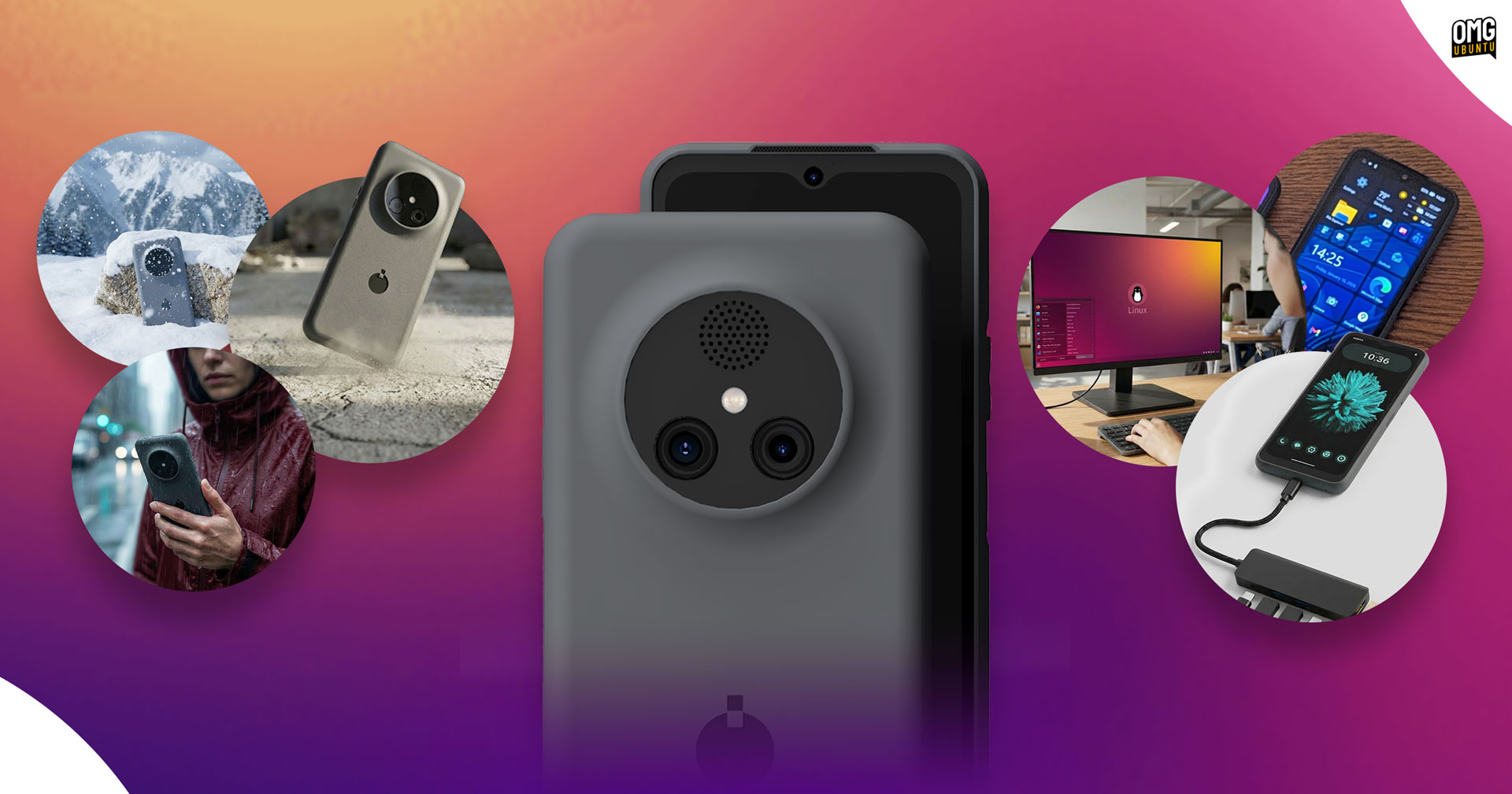
The 2026 proposition is straightforward: the NexPhone runs Android, Debian and Windows 11 on the same device, with a fully-featured USB Type-C cable enabling it to power a ‘desktop’ experience when connected to a monitor and input.
While Canonical’s convergence goals with Ubuntu Phone ultimately went nowhere1, quickly joined by Windows Phone and its ‘Continuum’ tech, the idea didn’t die.
Samsung ploughed away with its DeX endeavour. Though the DeX no longer uses Linux, its newer Android desktop mode pre-empted Google’s own approach at delivering an adaptive one (and that comes to more devices with Android 16).
NexPhone: Android, Debian + Windows
The NexPhone will ship with Android 16 as its primary operating system (including the Android Desktop mode for ‘convergence’ style computing). Also installed is Debian Linux and Windows 11.
Debian runs as an app with GPU acceleration on top of Android. When you connect the phone to a monitor and pair a keyboard and mouse (or attach to something like the CrowView Note with a USB-C cable), Debian morphs into a full Linux desktop experience.
You can use the Debian desktop on an external monitor an have the phone remain a functional Android system, the way Ubuntu for Android intended to work.

Don’t want Linux? You can reboot the phone into Windows 11. Arguably, this is the most interesting aspect of the device. Nex has created its own custom, grid-based UI that Windows 11 uses when booted on the handset alone.
Hooking it up to a screen reveals the traditional Windows 11 desktop for “proper” productivity.
Windows fans mourning the demise of Windows Phone will want to chase the ‘Continuum’ dream of a phone that becomes a PC. The NexPhone’s custom grid UI nods to Metro Live Tiles, so this is the closest thing to a Lumia 950 XL successor in a decade.
The Linux crowd? Savvy ‘penguinistas’ have been using tools like Termux and Andronix to shoehorn Debian containers onto Android for years. For those comfortable managing proot environments, a pre-baked solution is less compelling.
Hardware specs
The NexPhone uses a 2021 Qualcomm QCM6490 processor (Kryo 670), which is an interesting choice as it’s primarily a chip aimed at IoT devices (the FairPhone 5 uses it too). It’s built on the Snapdragon 778G architecture with 8 cores:
- 1x Cortex-A78 core @ 2.7GHz
- 3x Cortex-A78 cores @ 2.4GHz
- 4x Cortex-A55 ‘efficiency’ cores @ 1.9GHz
Why this chip? Because it’s the only chip that readily supports all three operating systems. The UEFI/EDK2 support allows it to boot Windows 11 on ARM natively. And as the QCM6490 is an enterprise-grade SoC, Qualcomm is supporting it until 2036.
Performance will be positively …acceptable. Fine for everyday phone use and simple desktop tasks, including coding, but compiling kernels or undertaking sprawling video edits? Eh, it’d be a push – and the phone battery isn’t finite.
There’s also 12GB RAM; 256GB onboard storage (expandable with a microSD card); and a 6.58-inch LCD screen running at 1080×2403 resolution with up-to-120Hz refresh rate.
Rear cameras are set in a ‘bump’, with a 64MP wide (Sony IMX787) and 13MP ultrawide (Samsung S5K3L6XX). A 10MP front-facing camera services unflattering under-the-chin selfies needs.
Rounding it out the usual stuff one would expect a mid-range Android phone, like fingerprint scanner and NFC, plus Wi-Fi 6E, Bluetooth 5.2 LE, GPS, and a slew of sensors (accelerometer, gyroscope, ambient light, proximity).
Where to buy the NexPhone
So far, so intrigued: so how much will it cost?
The NexPhone is currently slated to cost $549 (but we live in 2026 where tariffs blow in like the wind, and blow back out just as quick).
Small production runs of niche hardware rarely come cheap, so the price feels oddly fine for this. Not dirt cheap, but not outrageously expensive.
But here where things get a bit “here we go again”: manufacturing doesn’t begun until the latter half of the year. Would-be buyers can pay a $199 (refundable) deposit today, with the rest payable when the NexPhone is ready to ship.
Those early-bird deposits also qualify for a “free” USB-C dock, but those can be found on AliExpress for a dollar or two so reselling it won’t offset the purchase by much (sorry, savvy savers).
Worth it? Depends…
If you want to place a $200 deposit to ‘pre-order’ one, you can do so via the NexPhone website.
But with the expected delivery date in the distance, the middling IoT chipset could feel dated by the time this is in hand. For a device meant to last, starting its life with a five-year-old chip design is a gamble for buyers, even if the proposition is compelling.
Nex Computing themselves? They say this would be better as a secondary phone or rugged backup device rather than something to replace2 or rival flagship phones from other companies.
But they seem confident they can finally pull off this long-gestating dream. Conveniently, they have a warehouse full of ‘brainless’ laptop shells ready for you to buy alongside it — business convergence in action, that.
- Note the capitalisation; while a community-led continuation exists, it’s not by Canonical. They washed their hands of it in 2017, with Mark Shuttleworth saying he was ‘wrong’ to go hard on the idea of convergence given the challenges and resulting community fragmentation. ↩︎
- When the company selling you a phone suggest that you might want to use a different one as your main one, it helps to frame a purchase: this is about proposition more than specs. ↩︎