
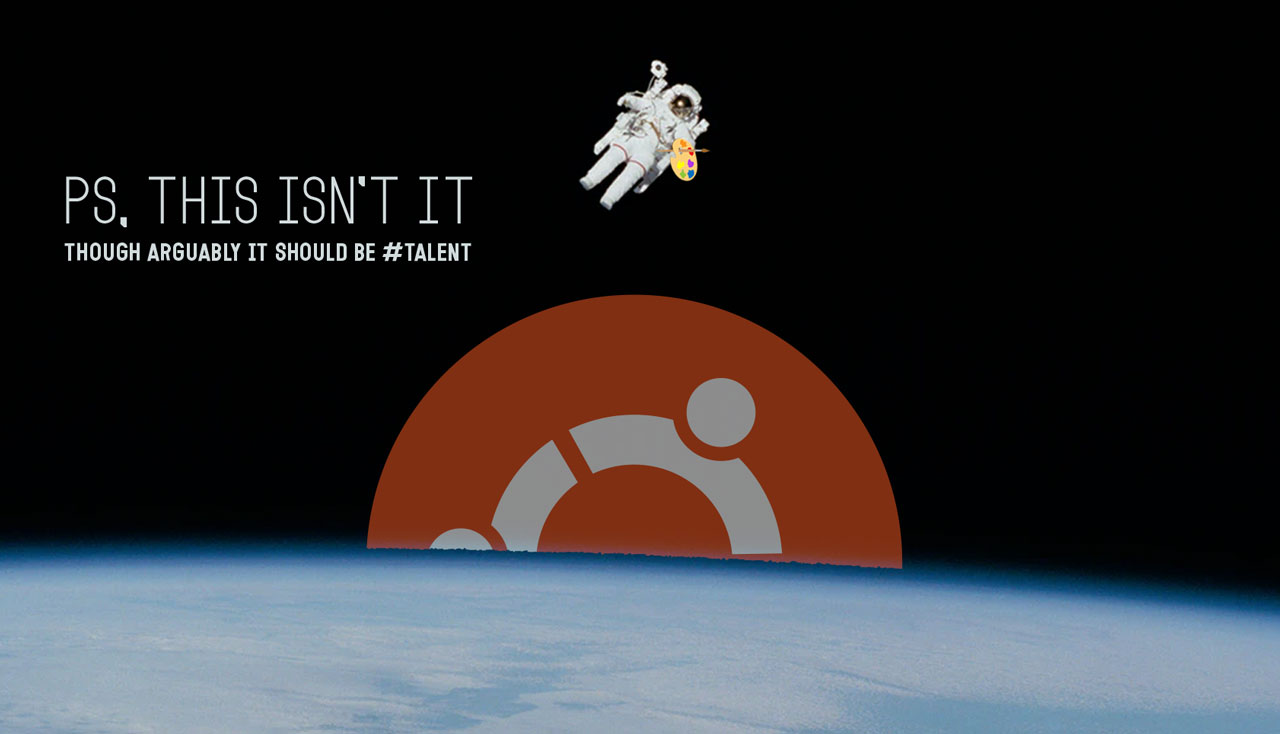

Canonical today announced new partnerships with NASA, the International Space Station (ISS) and an award winning artist.
Ubuntu (and Linux in general) is already used in a variety of practical space applications, from powering smart robots to helping rovers rove. But one area it’s yet to boldly go —sorry, couldn’t resist— is into the realm of cosmic creativity.
Until now, that is.
The ‘Celestium’ Project
Boundary-pushing artist Cecilie Waagner Falkenstrøm and the team at ARTificial Mind want to “advance the next epoch of digital art”. Their artistic tools of choice? Ubuntu Core, artificial intelligence, and, the universe.
The effort is part of a “groundbreaking, immutable data storage, edge processing demonstration currently running aboard the International Space Station” of which Ubuntu Core is a central component.
The far-out composition is called “Celestium“. It’s described as ”…an AI- and blockchain-generated piece that harnesses cosmic radiation to create unique artwork, as it orbits the Earth aboard NASA’s part of the International Space Station.”
FTs & NFTs
Now, from this point on I’m going to quote liberally from the press release Canonical sent over. This is because, like the actual ISS, the rest of what it says flys over my head.
”Harnessing data from cosmic radiation experienced aboard the ISS […] the AI algorithm is seeding and mining thousands of space images and space tokens to be distributed on a blockchain,” it reads.
“Drawing upon images from NASA’s deep space photographs, the unique works of Astronaut Nicole Stott of the Space for Art Foundation, and Western artist Tamara King, each image is generated by the AI as one-of-a-kind and embedded as a non-fungible token (NFT).”
Yikes — chances are that three letter acronym will draw a few deep sighs (and fevered debate) amongst folks.
Personally, I find idea of an AI (running on Ubuntu Core — nice) using data derived from cosmic radiation bombarding the ISS to create “art” an interesting concept that blurs boundaries between creativity, space and technology.
However, the rest I don’t get.
The “Celestium” artwork creates fungible digital ‘space’ tokens that we can collect back on terra firma. These space tokens can be “…exchanged to one of the 600,000 real asteroids that orbit our solar system, in the form of non-fungible tokens (NFTs).”
The release clarifies further: “Individuals are also allocated a piece of space debris equivalent to the amount that would be produced in the asteroids harvesting; as with all capitalist endeavours, follows the shared responsibility of the sustainable disposal of its generated waste products.”
“Each NFT has its own image generated by the AI. The AI itself is a generative adversarial network (GAN), trained on thousands of images of existing planets, stars, and nebulas across the cosmos, which it uses to generate images of its own unique celestial objects”.
I’m none the wiser!
Still, Ubuntu is out there to be used, even if every use may not be entirely to ones own taste.