



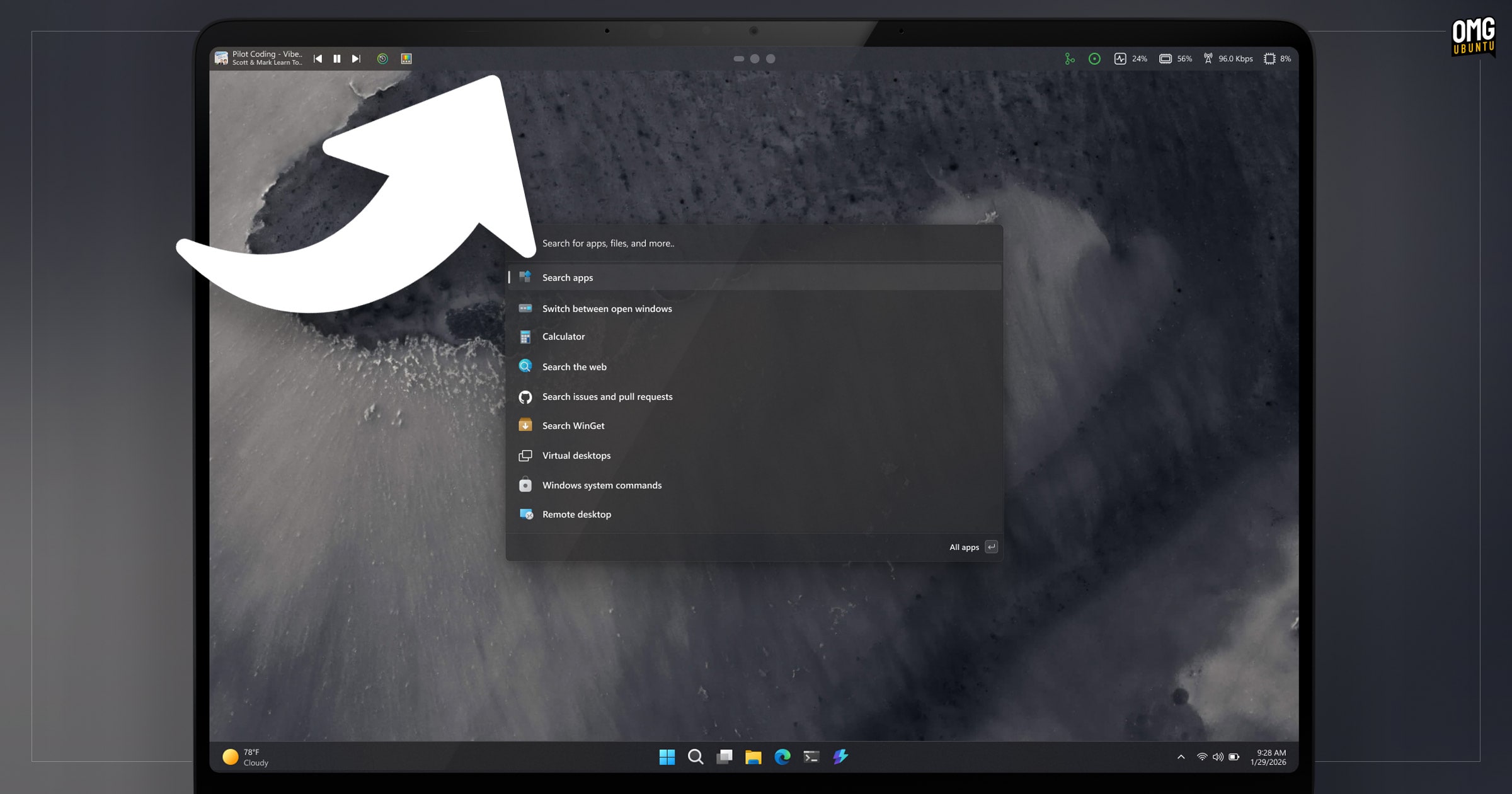
Microsoft is taking a cue from Linux with its new Command Palette Dock proposal for PowerToys, which lets Windows users add a second panel to their desktop complete with widgets, flexible positioning and custom theming.
That is functionality standard across most Linux desktop environments (and has been for decades), and a reminder of how inflexible Windows and the Taskbar is by default.
What is PowerToys?
PowerToys is a set of utilities for Windows power users, maintained by Microsoft but separate from Windows – they need to be installed manually.
It offers advanced features like colour pickers, file preview tools, and the popular Command Palette – things Linux desktops often have by default.
The idea, posted by Microsoft designer Niels Laute on GitHub, is to add a Command Palette Dock in PowerToys to complement the (popular) Command Palette.
Command Palette is a newer PowerToys feature that provides a keyboard-driven launcher for extensions that handle quick settings, system tools, and utilities.
This proposed dock would let users take those extensions and show/access them as widgets on a panel users can stick to any screen edge.
Learning from Linux is no bad thing
Laute’s mockups have the proposed Command Palette Dock along the top of the screen, and the standard (inflexible) Windows Taskbar on bottom. This reminds me of GNOME Shell, which is itself customisable with extensions.
And those “adaptable” extensions (read: widgets) that can be relocated to be accessed more easily? Clear echoes of the way KDE Plasma’s widgets/applets work.
Not to say there is intentional inspiration here; designers often reach similar UX/UI conclusions. Microsoft is adding a second bar because the first one is too rigid to move or modify.

Of course, on KDE or GNOME you can have everything you want in one bar, if you want. Microsoft’s solution to an inflexible Taskbar is to introduce a second one – one commenter likened the approach to a ‘pixel tax’.
Admittedly, I don’t pay that much attention to what Windows can or can’t do. I have a Windows 11 install that came with my Chuwi laptop. I use it to test Ubuntu for WSL and Linux apps ported to Windows (e.g., Clapper most recently). But I boot in 3 times a year at most.
So what caught my eye isn’t the feature, but the reminder of just how good we have it on Linux. We don’t have to wait for ‘blessed’ features to land, or wait for Microsoft to give permission or resort to sketchy hacks just to tweak a layout or move a panel somewhere we want.
Clearly, Windows users would rather not have to do that either. Plenty of Windows users are giving feedback (mainly of the “why not just make the regular Taskbar more customisable?” variety).
Windows needs to start listening to users
For now this is a proposal. Whether it graduates to become a feature in PowerToys…
From my pew in the peanut gallery, that is not my concern – but I imagine it will be Microsoft’s.
The Windows 10 support led to a surge of interest in Linux. Millions of users were unwilling to discard capable PCs to run Windows 11 – an OS continually derided even by its own fans for its incessant focus on ad, telemetry and AI (and bugs) – became aware of alternative choices.
Windows 11 is losing the room, as the saying goes. PowerToys is a bolt-on pack of features that plug gaps Windows lacks natively. I don’t want to point out the obvious…
But Microsoft ought to knuckle down on listening to what its users want, and make its main Taskbar more customisable rather than working a separate ‘surface’ the majority of users will never discover.
While this looks exciting, for now it is just a proposal. Even the fact Windows users will have to install a separate app to enjoy features Linux operating systems offer out-of-the-box reminds why I could never switch back.
via Neowin