





Ubuntu’s new AI-powered dictation tool Myna isn’t officially ready, but you can give it an early test.
Canonical has added the Myna orchestrator snap and a pair of speech-recognition AI models to the Snap Store recently, and made its new desktop Myna Settings tool available to test from a PPA.
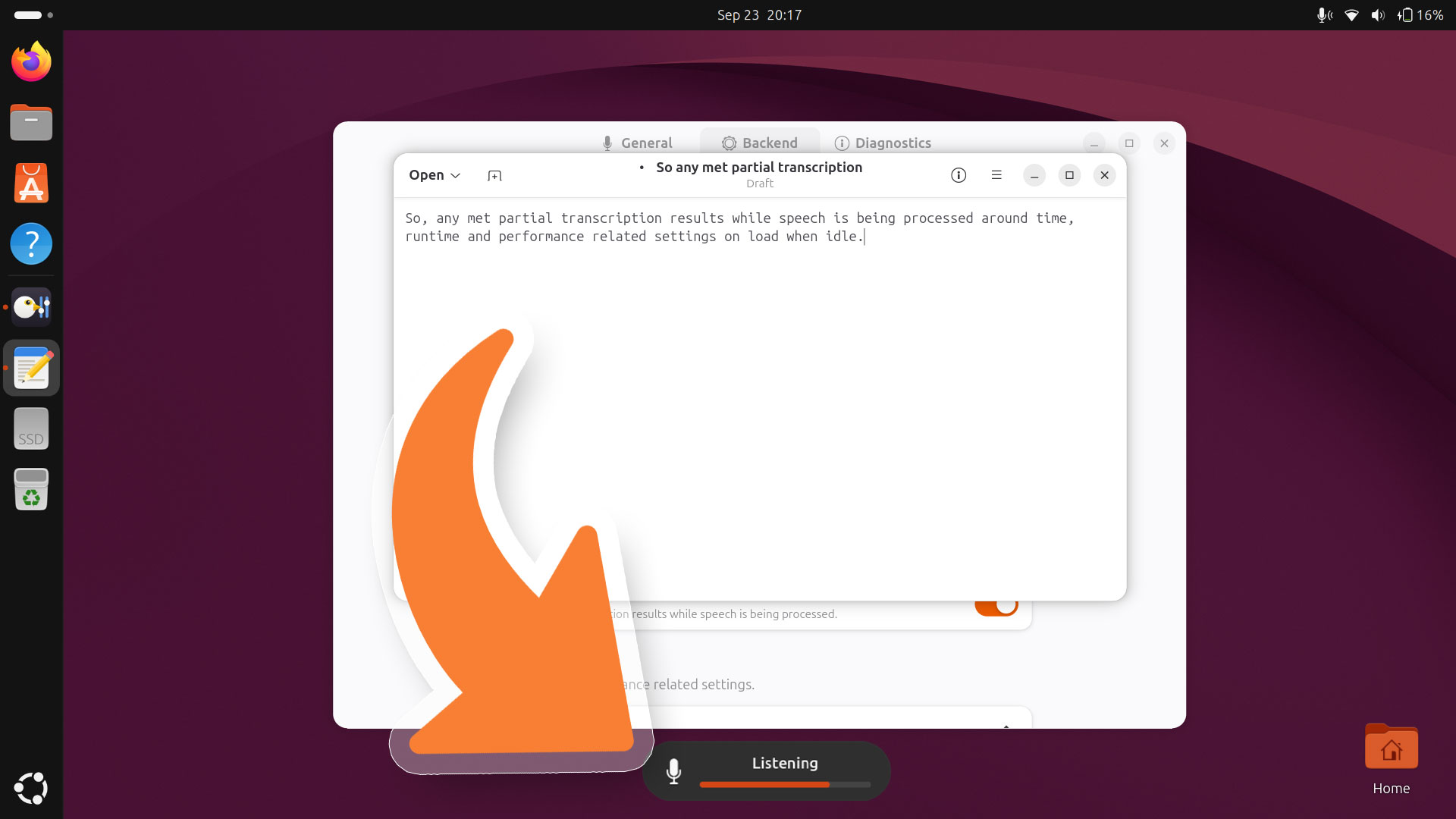
Ubuntu 26.10 also comes with another component preinstalled, as the gnome-shell-ubuntu-extensions package has a GNOME Shell extension that triggers an on-screen HUD when the Myna local AI speech-to-text tech is listening or transcribing.
While a formal call for testing hasn’t been made, all the pieces needed to test Myna are available – for those who care to put them together. The feature has changed quite a bit since I previewed it back in August.
If that includes you, read on for how to do it – but don’t expect things to work perfectly just yet, mind.
How to try Myna on Ubuntu
To test Myna on Ubuntu 26.04 LTS or Ubuntu 26.10 you need:
myna-configdesktop app from a PPAmynasnap from the Snap Store-
myna-*AI model from the Snap Store
If you’re on Ubuntu 26.10 you also have:
- Myna Shell extension (preinstalled)
As of writing, the Myna Shell extension (which triggers the on-screen HUD) is only packaged for GNOME 51 and 26.10. Desktop notifications are used to convey status on Ubuntu 26.04 instead.
The on-screen HUD will only appear after pressing the trigger key to activate Myna, when listening or transcribing, or conveying error states (like ‘background noise is high’ or ‘focus lost’).

There are different visual styles available for the HUD: default (a plain bar using the system accent colour); vumeter (think volume), ribbon (but as animated as the original one, alas) and bar (same to default but, in my test, lacks a trough):
Here’s how to install each component.
Installing the Myna Settings desktop app
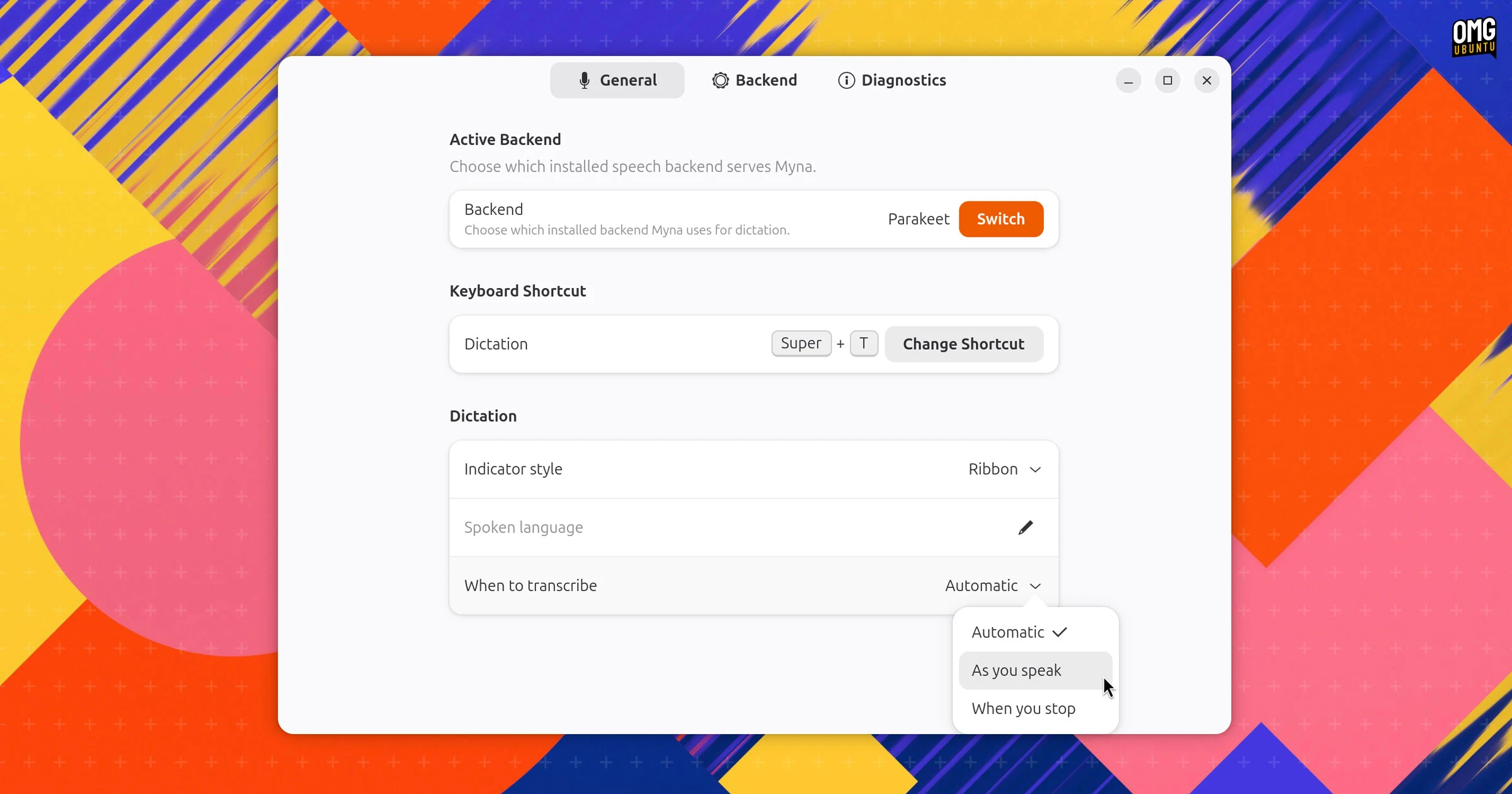
Install the Myna Settings app by adding the following PPA (maintained by a Canonical engineer working on Myna) which provides packages for Ubuntu 26.04 LTS and 26.10:
sudo add-apt-repository ppa:charles05/myna-config
sudo apt install myna-config
Installing the Myna client snap
Enable an experimental snap feature Myna requires before it will install:
sudo snap set system experimental.user-daemons=true
Install the Myna speech-to-text client from the Snap store:
sudo snap install myna --edge
Installing a text-to-speech AI model snap
Finally, to tie it all together, you’ll need the “brains” of the operation: an AI model which will actually transcribe your audio to typed text.
If you open the Myna Settings (myna-confg) setup tool it will suggest a model it thinks it suitable for your hardware. But if you click on the ‘install’ button it throws an error(as the app points to stable versions, and the myna-* model snaps are currently in testing.
So you’ll need to install the model by hand.
Whisper and Parakeet are two local AI models already on the Snap Store, but Funasr is expected to join them soon. The models run entirely locally, on your device, but aren’t small. You’ll need 1-2GB of free disk space1, depending on the one you choose.
I tested both. Parakeet I found better at accuracy (even spelling my surname correctly, which most don’t), but Whisper was faster, if prone to homophone errors.

You can, via the Myna Settings tool, set a model size (the number of parameters it uses) to favour speed or accuracy: smaller variants process audio faster on low-end hardware, while larger ones reduce transcription errors and handle tricky words better.
Install Parakeet, NVIDIA’s fast, open-weight ASR model supporting 25 languages and punctuation:
sudo snap install myna-parakeet --edge
Or install Whisper, OpenAI’s multilingual, open-source model:
sudo snap install myna-whisper --edge
Now, open Myna Settings and it should now skip past the setup screen and show you options.
Checking Myna works
With everything in place, you can go ahead and test. First thing: make sure your microphone is enabled and working (check in Settings > Sound > Input). You then need to assigned a hotkey shortcut in the settings app2 which you will press to activate the feature.
When ready, open an app and focus a text field (I tend to use Text Editor), and press your hotkey.
When activated, the Myna HUD will appear on the desktop (26.10) or in a notification (26.04). Begin to talk and, if Myna says “listening”, continue rambling until you’re done. Press the same hotkey to transcribe your spoken words in to text that will appear in the focused app.
If you click out of the text field you began dictating into (or another app opens and steals focus) the HUD will say “focus lost”. You’ll need to repeat the process again.
Is Myna any good?
Myna is a boon to Ubuntu’s accessibility, for sure. Offline AI-powered dictation that’s more accurate than what’s previously been available.
Whether dictation proves popular beyond that, in day-to-day usage, is an open question. Offline speech recognition has shipped on smartphones and smartwatch for years, but most people still type their WhatsApp messages, e-mails and (welp) ChatGPT prompts.
Dictation is remains best suited to longer-form text entry than, say, barking “Firefox” at the App Picker. Myna can lose focus easily (an app opens, you press a button, you mouse away), and thus lose any “spiel” it was in the middle of processing.
It’s also optional; it only “listens” when you press a button, and recorded clips never leave your device nor get stored on it. It also can’t be triggered with a “hey myna” – not yet anyway.
Ubuntu didn’t have any of this before Myna, so it’s great to see Canonical experimenting. Myna is even being developed as a desktop-agnostic tech, even if this first pass focuses on a GNOME/Wayland/Mutter stack.
- Snap is configured to keep one “good” backup of everything you install, so when it gets updated the only one stays behind, meaning each snap uses twice the amount of space. ↩︎
- On one of my laptops Myna defaults to super + j but on another it uses super + t. You can see/change it in the Myna Settings app. ↩︎